Media Summary: Not all values of V are solutions to the gradient wind balance. Here, we list out what situations are theoretical possible. A graphical representation of what we explored in the previous Remember the good ol' quadratic equation?

Metr2023 Lecture 11 Segment 2 - Detailed Analysis & Overview

Not all values of V are solutions to the gradient wind balance. Here, we list out what situations are theoretical possible. A graphical representation of what we explored in the previous Remember the good ol' quadratic equation? A look at what our Cartesian wind vector (in terms of u, v, and w) looks like in natural coordinates. A first look at the second apparent force that arises from a rotating (non-inertial) reference frame. Also, here's a nice little animation ... A look at some of the physical consequences behind the centripetal and centrifugal forces.

What the acceleration vector looks like in natural coordinates. A look at some of the physical consequences behind the Hypsometric Equation. A look at surface cold fronts. Cold fronts that occur above ground level (often referred to as a Cold Front Aloft or CFA) can rapidly ... A closer look at turbulence, including some of the mathematics behind turbulence. A first look at the gradient wind balance, where we start to account for centrifugal force. A look at a (relatively) simple parameter which can tell us something about the scale of a particular atmospheric phenomenon.

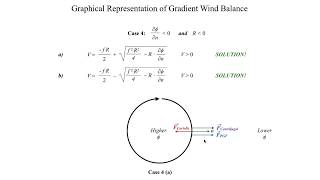
Photo Gallery

METR2023 - Lecture 11 - Segment 2: Mathematical Solutions of the Gradient Wind Balance
METR2023 - Lecture 11 - Segment 3: Illustrating the Solutions of the Gradient Wind Balance
METR2023 - Lecture 11 - Segment 1: Solving for V in the Gradient Wind Balance
METR2023 - Lecture 10 - Segment 2: Wind Vector in Natural Coordinates
METR2023 - Lecture 5 - Segment 2: Introduction to Coriolis Force
METR2023 - Lecture 4 - Segment 2: Physical Consequences of Centripetal and Centrifugal Force
Meteorology - Chapter 11 Lecture 2 of 4
METR2023 - Lecture 10 - Segment 3: Horizontal Acceleration Vector in Natural Coordinates
METR2023 - Lecture 3 - Segment 2: Physical Interpretation of the Hypsometric Equation
METR2023 - Lecture 19 - Segment 2: Cold Fronts
METR2023 - Lecture 24 - Segment 2: Turbulence
METR2023 - Lecture 7 - Segment 2: Gradient Wind Balance
View Detailed Profile
METR2023 - Lecture 11 - Segment 2: Mathematical Solutions of the Gradient Wind Balance

METR2023 - Lecture 11 - Segment 2: Mathematical Solutions of the Gradient Wind Balance

Not all values of V are solutions to the gradient wind balance. Here, we list out what situations are theoretical possible.

METR2023 - Lecture 11 - Segment 3: Illustrating the Solutions of the Gradient Wind Balance

METR2023 - Lecture 11 - Segment 3: Illustrating the Solutions of the Gradient Wind Balance

A graphical representation of what we explored in the previous

METR2023 - Lecture 11 - Segment 1: Solving for V in the Gradient Wind Balance

METR2023 - Lecture 11 - Segment 1: Solving for V in the Gradient Wind Balance

Remember the good ol' quadratic equation?

METR2023 - Lecture 10 - Segment 2: Wind Vector in Natural Coordinates

METR2023 - Lecture 10 - Segment 2: Wind Vector in Natural Coordinates

A look at what our Cartesian wind vector (in terms of u, v, and w) looks like in natural coordinates.

METR2023 - Lecture 5 - Segment 2: Introduction to Coriolis Force

METR2023 - Lecture 5 - Segment 2: Introduction to Coriolis Force

A first look at the second apparent force that arises from a rotating (non-inertial) reference frame. Also, here's a nice little animation ...

METR2023 - Lecture 4 - Segment 2: Physical Consequences of Centripetal and Centrifugal Force

METR2023 - Lecture 4 - Segment 2: Physical Consequences of Centripetal and Centrifugal Force

A look at some of the physical consequences behind the centripetal and centrifugal forces.

Meteorology - Chapter 11 Lecture 2 of 4

Meteorology - Chapter 11 Lecture 2 of 4

Introduction to Meteorology

METR2023 - Lecture 10 - Segment 3: Horizontal Acceleration Vector in Natural Coordinates

METR2023 - Lecture 10 - Segment 3: Horizontal Acceleration Vector in Natural Coordinates

What the acceleration vector looks like in natural coordinates.

METR2023 - Lecture 3 - Segment 2: Physical Interpretation of the Hypsometric Equation

METR2023 - Lecture 3 - Segment 2: Physical Interpretation of the Hypsometric Equation

A look at some of the physical consequences behind the Hypsometric Equation.

METR2023 - Lecture 19 - Segment 2: Cold Fronts

METR2023 - Lecture 19 - Segment 2: Cold Fronts

A look at surface cold fronts. Cold fronts that occur above ground level (often referred to as a Cold Front Aloft or CFA) can rapidly ...

METR2023 - Lecture 24 - Segment 2: Turbulence

METR2023 - Lecture 24 - Segment 2: Turbulence

A closer look at turbulence, including some of the mathematics behind turbulence.

METR2023 - Lecture 7 - Segment 2: Gradient Wind Balance

METR2023 - Lecture 7 - Segment 2: Gradient Wind Balance

A first look at the gradient wind balance, where we start to account for centrifugal force.

METR2023 - Lecture 13 - Segment 2: Rossby Number

METR2023 - Lecture 13 - Segment 2: Rossby Number

A look at a (relatively) simple parameter which can tell us something about the scale of a particular atmospheric phenomenon.